
The world of art is abuzz with excitement as the Philadelphia Museum of Art (PMA) prepares to host a groundbreaking exhibition that brings together two legendary versions of Vincent van Gogh's "Sunflowers" paintings. Titled "Van Gogh's Sunflowers: A Symphony in Blue and Yellow," this show promises to offer art enthusiasts a rare opportunity to witness the Dutch master's innovative use of color, brushwork, and emotional depth side by side. Scheduled to run from June 6 to October 11, 2026, the exhibition not only highlights van Gogh's creative process during his transformative period in Arles, France, but also underscores the historical significance of these works in the Post-Impressionist movement.
Vincent van Gogh, one of the most influential artists in history, created his famous "Sunflowers" series during a prolific burst of creativity in the late 1880s. Born in 1853 in the Netherlands, van Gogh's life was marked by intense passion, mental health struggles, and a relentless pursuit of artistic expression. His self-portraits, such as the one depicting him with a felt hat against a swirling blue background, reveal a man deeply introspective and innovative.
These qualities shine through in the "Sunflowers" paintings, which he produced while living in the Yellow House in Arles—a modest dwelling he hoped would become a haven for fellow artists like Paul Gauguin.
In August 1888, van Gogh painted four still lifes featuring sunflowers, inspired by the vibrant Provençal landscape. These included a composition with three blooms (now in a private collection) and another with six (tragically destroyed during World War II in Japan). The most celebrated originals are the version with 14 sunflowers against a turquoise-blue background, housed at Munich's Neue Pinakothek, and the 15-sunflower arrangement on a yellow background, part of the National Gallery's collection in London. Several months later, in January 1889, van Gogh created replicas, including the turquoise-background version that now resides at the PMA. This copy was sent to his brother Theo in Paris and was originally intended for Gauguin, reflecting van Gogh's desire to foster artistic collaboration.
The PMA's "Sunflowers" (1889) features a striking turquoise backdrop that contrasts vividly with the golden hues of the flowers, creating a sense of depth and movement through van Gogh's signature impasto technique—thick, textured layers of paint that give the petals a three-dimensional quality.
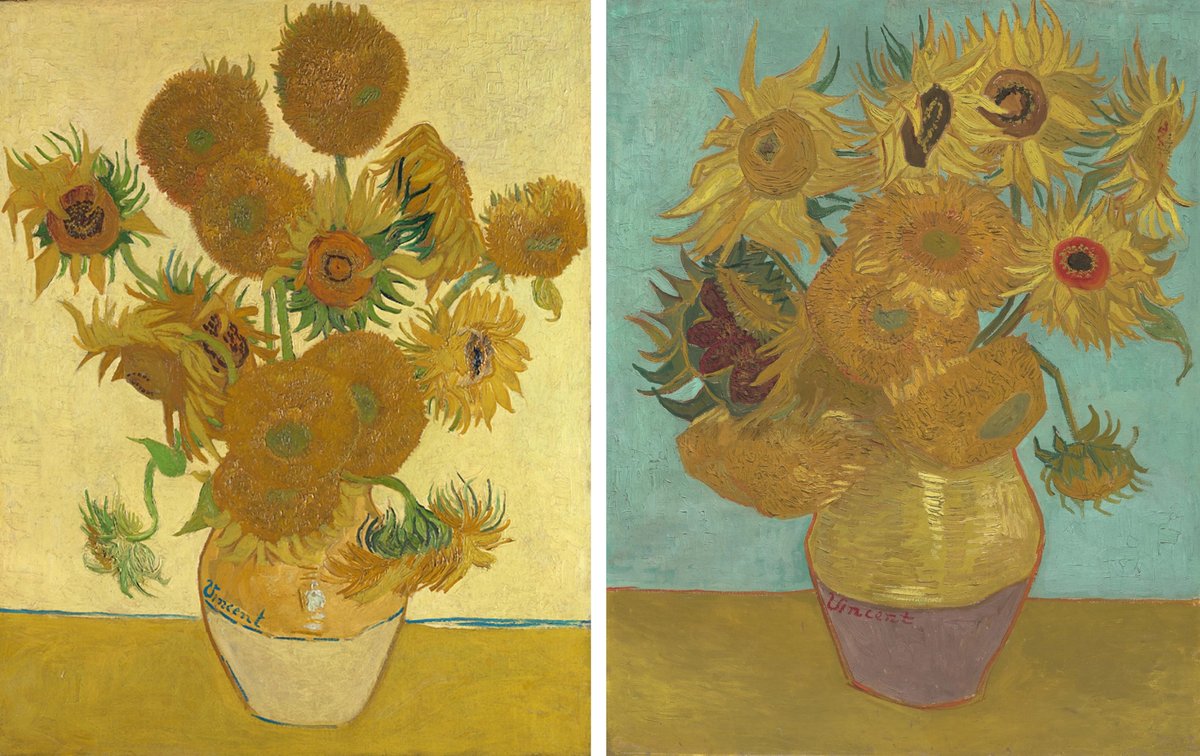
In contrast, the National Gallery's version (1888) employs a pale yellow background, emphasizing warmth and luminosity, with the sunflowers appearing almost radiant under an imagined southern sun. By displaying these two paintings together, the exhibition allows visitors to compare subtle differences in color choices, brushstrokes, and emotional resonance. As curator Jennifer Thompson notes, the show will explore "how the artist used colour and brushwork to achieve different expressive effects."
The title of the exhibition draws directly from van Gogh's own words in a letter to Theo dated August 21-22, 1888, where he described the series as "a symphony in blue and yellow." This phrase encapsulates his fascination with complementary colors—blue and yellow—to evoke harmony and vibrancy, much like musical notes in a composition. The PMA's version, with its cooler tones, might suggest a more contemplative mood, while the London's warmer palette conveys optimism and energy. Art historians often interpret the sunflowers as symbols of gratitude, life cycles, and van Gogh's longing for connection, especially during his isolation in Arles.
The provenance of the PMA's painting adds another layer of intrigue. Acquired in 1895 by Count Antoine de La Rochefoucauld for a mere equivalent of $80, it passed through hands until 1928, when collector Carroll Tyson purchased it via Paris dealer Paul Rosenberg for about $45,000. Upon his wife Helen's death in 1963, it was bequeathed to the museum, where it has become a cornerstone of their collection. This exhibition marks a reciprocal gesture following the PMA's loan of its "Sunflowers" to the National Gallery's "Van Gogh: Poets & Lovers" show, which ran from September 14, 2024, to January 19, 2025. That London exhibition reunited the PMA's painting with its London counterpart for the first time since 1889, displaying them in a triptych alongside "La Berceuse (The Lullaby)"—a arrangement van Gogh sketched in a letter to Theo on May 23, 1889. It was the first time the PMA's work traveled outside the U.S. since its acquisition, highlighting the rarity of such loans.
During the London loan, curator Thompson oversaw the reframing of the PMA's painting in a simpler style, inspired by a 17th-century Italian frame used by the National Gallery in 1999. The new frame, which includes authentic woodworm holes for character, enhances the display without being an exact replica and will be retained for the 2026 show. This attention to detail underscores the PMA's commitment to presenting van Gogh's works in a context that honors his original vision.
The exhibition is set against the iconic backdrop of the Philadelphia Museum of Art, a neoclassical landmark perched atop the steps made famous by the "Rocky" films.

Founded in 1876, the PMA boasts over 240,000 works spanning 2,000 years, including masterpieces by Renoir, Monet, and Picasso. Hosting this van Gogh show continues its tradition of major exhibitions, such as past retrospectives on Impressionism and modern art. Despite recent administrative changes at the museum, including the departure of Director Sacha Suda, the exhibition remains a highlight of the PMA's schedule, promising to draw international crowds.
Beyond the two central "Sunflowers," the show may include related artifacts, such as letters from the Van Gogh Museum archives, sketches, or contextual pieces from van Gogh's Arles period. Visitors can expect interactive elements, like close-up analyses of brushwork via digital displays, to deepen appreciation for van Gogh's technique. The exhibition also ties into broader themes in art history, such as the influence of Japanese prints on van Gogh's bold colors and the role of still lifes in expressing human emotion.
In Arles, van Gogh's "Yellow House" served as both studio and symbol of his utopian dreams for an artists' colony.

Painted by van Gogh himself in 1888, it depicts the sunny corner building under a cobalt sky, buzzing with everyday life. This setting was where he created the original "Sunflowers" to decorate Gauguin's room, hoping to impress his friend and collaborator. Tragically, their relationship soured, leading to van Gogh's infamous ear incident, but the paintings endure as testaments to his optimism.
Art lovers should mark their calendars for this once-in-a-lifetime event. Tickets are expected to go on sale in early 2026 via the PMA's website, with possible member previews and guided tours. The exhibition not only celebrates van Gogh's genius but also fosters international collaboration between institutions like the PMA and the National Gallery, reminding us of art's power to connect across time and borders.
FAQ
What is the "Van Gogh's Sunflowers: A Symphony in Blue and Yellow" exhibition about?
The exhibition focuses on two versions of Vincent van Gogh's "Sunflowers" paintings—one from the Philadelphia Museum of Art (1889, turquoise background) and one from London's National Gallery (1888, yellow background). It explores van Gogh's techniques, color use, and the historical context of the works.
When and where will the exhibition take place?
It will run from June 6 to October 11, 2026, at the Philadelphia Museum of Art in Philadelphia, Pennsylvania.
Why are these two paintings significant?
They represent original and replica works from van Gogh's Arles period, showcasing his experimentation with color harmony. Reuniting them allows for direct comparison, a rare occurrence since 1889.
Is this related to the recent London exhibition?
Yes, it's a reciprocal loan. The PMA lent its "Sunflowers" to the National Gallery's "Van Gogh: Poets & Lovers" show (2024-2025), and now London is lending theirs to Philadelphia.
How can I get tickets?
Tickets will be available through the Philadelphia Museum of Art's website. Check for updates closer to the opening date.
Will there be additional artworks or features?
While details are forthcoming, the show may include van Gogh's letters, sketches, and digital interactives to enhance understanding of his process.
What is the admission fee?
Admission details have not been announced yet, but the PMA typically offers pay-what-you-wish options on certain days. Visit their site for the latest information.