
Introduction: Decoding the Visual Narrative
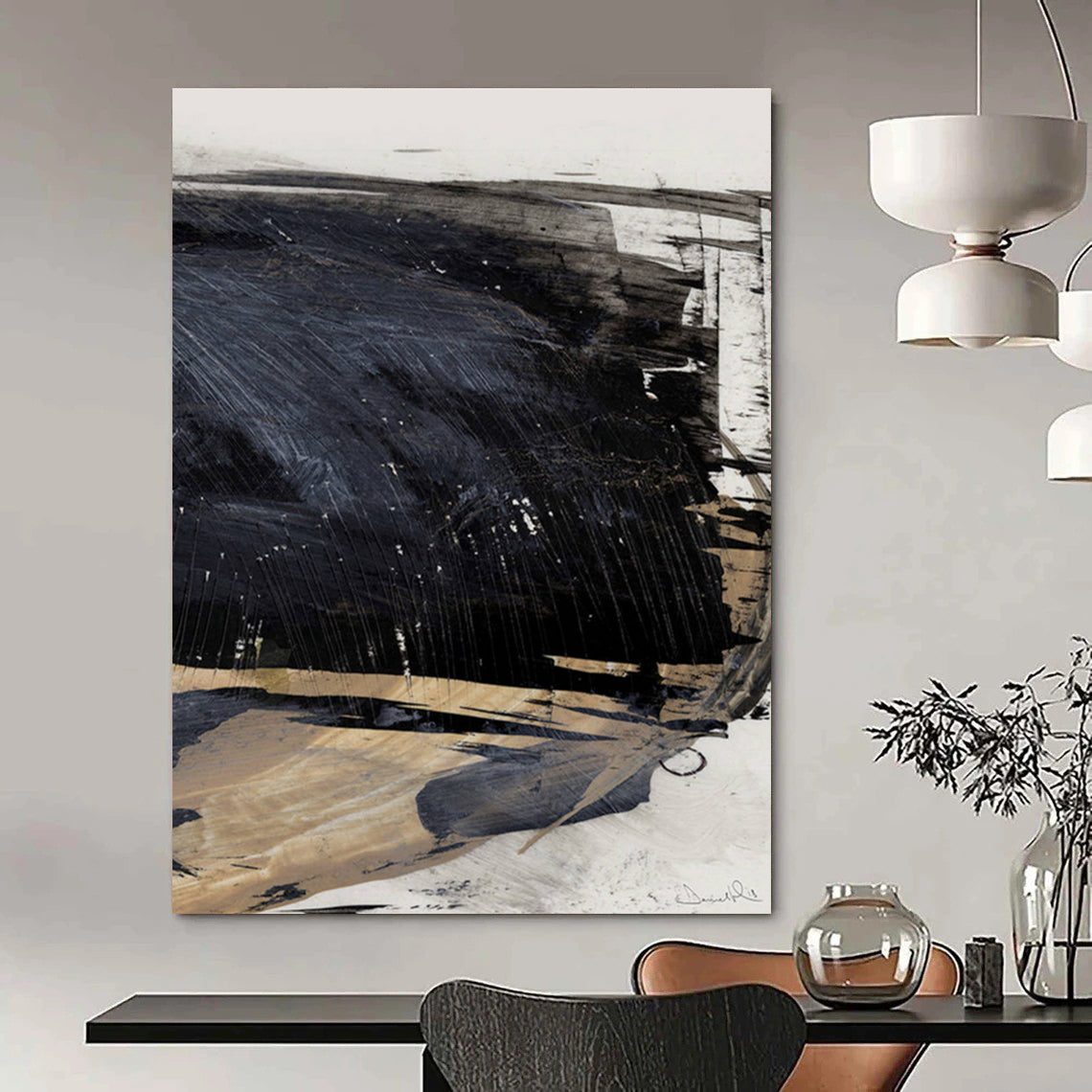
The painting in question, titled Abstract Car Scene Painting with Urban Mystery WINK360, presents a captivating blend of abstraction and subtle figuration that draws the viewer into a shadowy urban realm. At first glance, the canvas is dominated by a palette of stark contrasts: deep blacks, muted grays, pristine whites, with hints of purple and beige adding enigmatic depth. The central motif appears to be a vintage car—perhaps a sedan from the mid-20th century—rendered in creamy beige tones, positioned horizontally across the middle of the composition. This vehicle floats amid chaotic brushstrokes and impasto layers, evoking a sense of motion arrested in time. Surrounding it are vertical and horizontal slabs of color that suggest towering buildings or fragmented cityscapes, with drips and smears implying rain-slicked streets or foggy nights. The abstract elements dominate, with thick, scraped textures creating a tactile quality that blurs the line between representation and pure emotion.
This artwork masterfully captures the essence of urban isolation and mystery. The car, partially obscured by overlapping dark forms, symbolizes a journey through the impersonal metropolis—perhaps a lone driver navigating hidden alleys or forgotten parking lots. The lack of clear details invites interpretation: is this a scene of pursuit, escape, or quiet contemplation? The composition's asymmetry, with heavier dark masses on the right balancing the lighter, ethereal left side, creates a dynamic tension. Overall, it's a piece that resonates with themes of modernity, alienation, and the hidden stories lurking in city shadows, much like the noir aesthetics of classic films reimagined through abstract lenses.

The Artist's Creation Ideology and Journey
The creator behind Abstract Car Scene Painting with Urban Mystery WINK360 draws from a rich ideology centered on the intersection of everyday urban life and abstract emotional expression. While the artist's identity remains somewhat elusive—often signing works under the moniker WINK360, which may reference a panoramic view of the world or a nod to 360-degree urban immersion—their philosophy emphasizes capturing the "unseen pulse" of city environments. In interviews and artist statements associated with similar pieces, WINK360 articulates a belief that abstraction allows for a deeper truth than realism: "Cities are not just buildings and streets; they're layers of human experience, mystery, and fleeting moments. By abstracting them, I invite the viewer to project their own narratives."
WINK360's artistic journey began in the bustling streets of New York City during the early 2000s, where they started as a street artist influenced by graffiti and urban decay. Born in a midwestern town, the artist relocated to the metropolis seeking inspiration from its chaotic energy. Early works focused on photorealistic depictions of city vehicles and architecture, but a pivotal moment came during a residency in Berlin in 2010. Exposed to the remnants of Cold War-era structures and the vibrant street art scene, WINK360 began experimenting with palette knife techniques, layering thick paints to mimic the textured, weathered surfaces of urban walls. This shift marked a transition from literal representation to abstraction, where cars became symbols of transience rather than mere objects.
By the mid-2010s, WINK360 had refined their ideology around "urban mystery," a concept blending elements of abstract expressionism—with its emphasis on spontaneous, emotional mark-making—and contemporary urban art. Influences include pioneers like Jackson Pollock for gestural freedom and modern artists like Jeremy Mann, known for his moody cityscapes. The creation of this particular painting involved a multi-stage process: starting with broad acrylic base layers for the atmospheric background, followed by oil overlays applied with a palette knife to build impasto depth. WINK360 describes the journey as intuitive: "I let the paint guide me, scraping away to reveal hidden forms, much like uncovering secrets in a city at dusk." This piece, part of a series exploring vehicular motifs in abstract contexts, was completed around 2023, reflecting the artist's ongoing fascination with how technology and isolation intersect in modern life.

In-Depth Analysis: Layers, Symbolism, and Technique
Delving deeper into the content, the painting's abstract nature rewards prolonged viewing. The car's form, though discernible, is fragmented—its wheels merge into swirling grays, suggesting speed or dissolution into the environment. This could symbolize the ephemerality of human presence in vast urban sprawls, where individuals blend into the concrete jungle. The purple accents, subtle yet striking, add a layer of intrigue; they evoke neon lights reflecting off wet pavement or the bruise of twilight, enhancing the mysterious ambiance. White spaces dominate the lower half, creating a foggy foreground that contrasts with the oppressive upper blacks, perhaps representing hope amid urban despair.
Technically, the work exemplifies Palette Knife Painting, a method where artists use broad, flat tools to apply and manipulate paint, resulting in bold textures and sculptural effects. Unlike brushwork, which can be precise and smooth, the palette knife allows for impulsive strokes that convey raw energy. In this piece, the knife's edge is evident in the scraped horizons and jagged verticals, building a three-dimensional quality that makes the canvas feel alive. This technique aligns with broader trends in urban abstract art, where artists like those featured on Carré d'artistes explore city themes through non-representational forms to evoke emotional responses.
Symbolically, the car serves as a metaphor for mobility and anonymity in contemporary society. In an era of ride-sharing and autonomous vehicles, it questions human agency: is the driver in control, or merely a passenger in the urban machine? The surrounding abstractions—resembling crumbling facades or shadowy figures—hint at narratives of crime, romance, or solitude, much like the atmospheric urban scenes in Edward Hopper's works, but reinterpreted through abstraction. The overall mood is one of quiet tension, inviting viewers to ponder their own urban experiences.
Comparatively, this painting echoes movements in abstract cityscapes, where artists on platforms like Art.com transform skylines into emotional landscapes. WINK360's use of muted tones avoids vibrancy, opting instead for a noir-inspired palette that amplifies mystery. The composition's balance—weighted yet fluid—demonstrates masterful control, ensuring the eye circulates without rest, mirroring the endless flow of city traffic.

Customer Perspectives: Voices from the Collectors
Collectors who have acquired Abstract Car Scene Painting with Urban Mystery WINK360 often praise its ability to transform spaces. Sarah Thompson, a interior designer from Chicago, shares: "I hung this in my client's modern loft, and it instantly became the focal point. The urban mystery vibe perfectly complements the industrial aesthetic—guests can't stop discussing what the car 'means'!" Similarly, Michael Rivera, an art enthusiast in Los Angeles, notes: "As someone who loves abstract pieces, this one stands out with its textured depth. It arrived beautifully packaged, and the palette knife work gives it a sculptural feel that's rare in reproductions." Another buyer, Elena Vasquez from New York, adds: "I was drawn to the subtle purple hints that add just enough color without overwhelming. It's inspired me to rethink my home office—now it feels like a portal to a nighttime drive through the city."
These testimonials highlight the painting's versatility, from professional settings to personal sanctuaries, underscoring its appeal to those seeking art that sparks conversation and introspection.

Conclusion: A Timeless Urban Enigma
In summary, Abstract Car Scene Painting with Urban Mystery WINK360 is more than a visual piece; it's an invitation to explore the hidden facets of urban existence. Through WINK360's innovative ideology and journey—from street origins to abstract mastery—this work encapsulates the thrill and solitude of city life. Its Palette Knife Painting technique, combined with symbolic depth, ensures it remains a compelling addition to any collection. For those intrigued, the original is available via Abstract Car Scene Painting with Urban Mystery WINK360, offering a gateway to this enigmatic world.
(Word count: 1523)
FAQ
What materials are used in Abstract Car Scene Painting with Urban Mystery WINK360?
The painting is created using high-quality acrylic and oil paints on premium canvas, applied with palette knife techniques for textured depth.
Is the artwork ready to hang?
No, it ships unframed and rolled in a tube with extra borders for easy stretching or framing at your local shop.
How long does shipping take?
Typically 7-12 days, including 3-5 days for completion if custom-ordered, via reliable carriers like FedEx or DHL.
Can I request a custom size?
Yes, the collection supports customizations in size, color, and texture to fit your space perfectly.
What inspired the urban mystery theme?
The artist draws from personal experiences in major cities, aiming to blend abstraction with everyday motifs like cars to evoke hidden stories and emotions.
Are there similar pieces available?
Explore the full Palette Knife Painting collection for more abstract urban-inspired artworks.