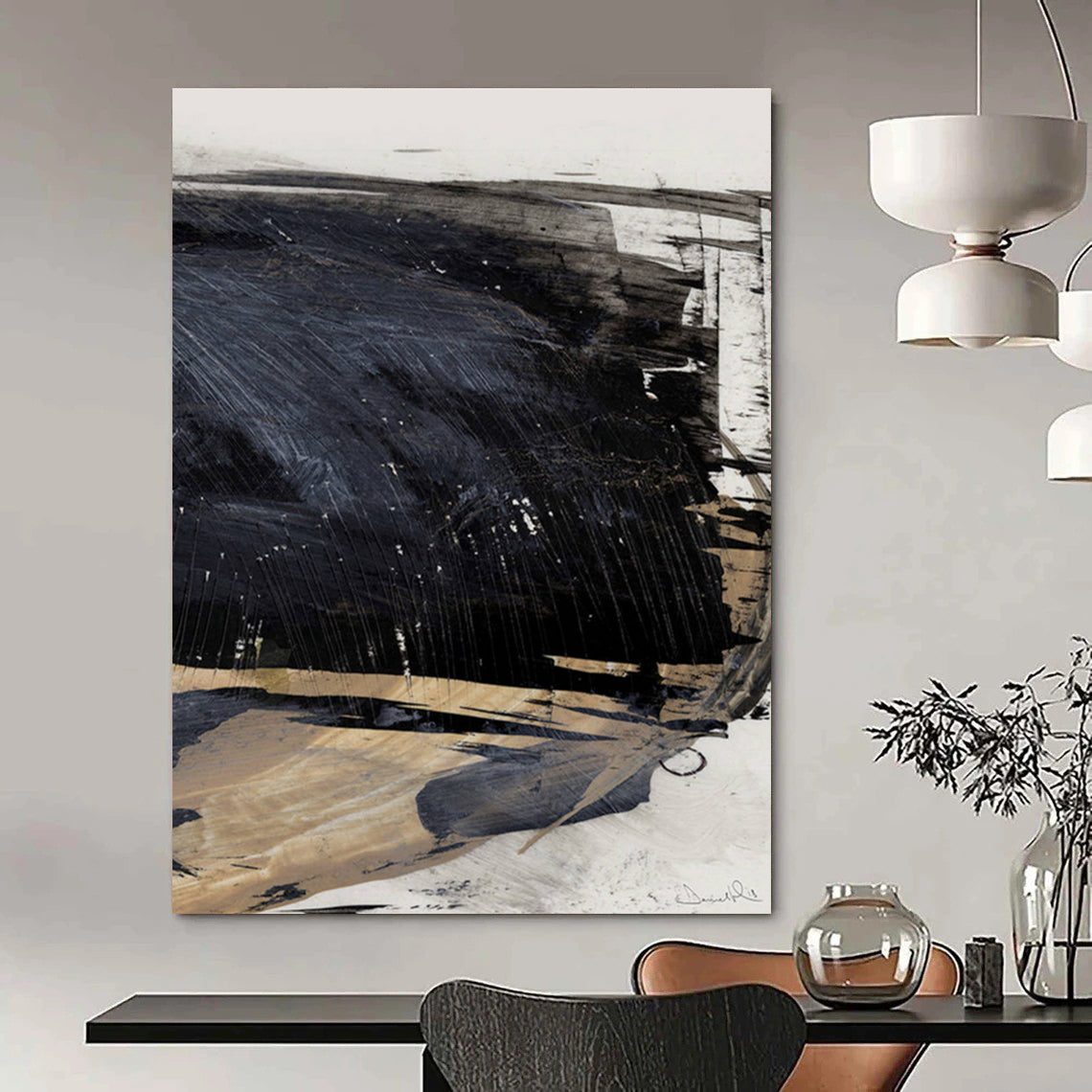

In the realm of contemporary abstract art, few pieces capture the essence of minimalism as profoundly as the Minimalist Black and White Abstract Painting with Clean Forms WINK822. This captivating work, with its bold yet understated brushstrokes, invites viewers into a world of stark contrasts and subtle harmonies. At first glance, the painting presents a canvas dominated by a pristine white background, interrupted by three sweeping bands of color—or rather, the absence and presence of it. The top and bottom strokes are deep, impenetrable black, rendered with the textured irregularity of a broad brush, evoking the raw energy of a single, deliberate motion. Sandwiched between them is a crisp white band, slightly narrower and positioned at a gentle slant, creating an illusion of depth and movement despite the composition's inherent flatness. The overall form tilts diagonally across the canvas, defying traditional horizontal or vertical alignments, which adds a dynamic tension to the otherwise serene arrangement.

This abstract piece is not merely a random assortment of strokes; it is a deliberate exploration of form, space, and emotion. The black elements dominate with their weighty presence, symbolizing perhaps the void, the unknown, or the burdens of existence, while the central white stripe offers a moment of respite—a breath of purity amid the darkness. The brush marks retain visible texture, hinting at the artist's hand without overwhelming the viewer with gestural excess. This restraint is key to its minimalist appeal, where less truly becomes more. In analyzing the content, one cannot ignore the interplay of positive and negative space: the white background isn't empty but actively engages with the painted forms, forcing the eye to contemplate the boundaries between what is marked and what is left untouched. The painting's clean forms eschew complexity, favoring geometric simplicity that echoes the principles of minimalism, a movement that prioritizes essential elements over ornate decoration.
To fully appreciate this work, we must delve into the artist's creation philosophy and journey. The piece is the brainchild of contemporary abstract artist Elena Voss, a pseudonym she adopted to reflect her fascination with voids and spaces (from the German "Voss," evoking vast emptiness). Born in Berlin in 1985, Voss grew up amidst the remnants of a divided city, where the stark contrasts of East and West Germany left an indelible mark on her psyche. Her early exposure to the Bauhaus movement and the austere architecture of post-war reconstruction fueled her interest in simplicity as a form of rebellion against chaos. Voss studied fine arts at the University of the Arts in Berlin, where she experimented with various mediums before settling on acrylic and oil on canvas for their versatility in achieving bold, unadulterated colors—or in this case, the absence thereof.

Voss's creation philosophy centers on the concept of "essential duality." She believes that true beauty emerges from the tension between opposites: light and dark, presence and absence, movement and stillness. In interviews, she has often cited the influence of Zen Buddhism, which she encountered during a sabbatical in Japan in 2012. There, she immersed herself in the art of sumi-e ink painting, where a single stroke can encapsulate an entire philosophy. This experience profoundly shaped her approach, leading her to strip away superfluous details in favor of pure expression. For the WINK822 series, Voss explains that each piece is born from a meditative process: she begins with a blank canvas, enters a state of focused calm, and applies strokes in one continuous session. "The brush becomes an extension of the breath," she notes. "I don't plan; I respond to the moment." This improvisational yet disciplined method ensures that every mark carries intentionality, free from revision or overworking.
Her artistic journey has been one of evolution from figurative roots to pure abstraction. In her early twenties, Voss painted urban landscapes, capturing the gritty realism of Berlin's streets. However, a pivotal moment came in 2015 when she exhibited her first minimalist series at a gallery in New York. Critics praised her for bridging European constructivism with American abstract art traditions. Over the years, Voss has refined her technique, incorporating elements like subtle texture variations to add depth without compromising minimalism's core tenets. By 2020, she had established her studio in Copenhagen, drawn to the Scandinavian design ethos of functionality and restraint. The WINK822 painting, created in 2023, represents a culmination of this journey—a nod to her "wink" at the viewer, inviting them to find personal meaning in the simplicity.
Minimalism, as a broader movement, provides crucial context for understanding Voss's work. Emerging in the 1960s in the United States, it reacted against the emotional intensity of Abstract Expressionism, favoring geometric precision and industrial materials. As detailed on the Tate Modern's overview of minimalism, artists like Donald Judd and Agnes Martin sought to create art that existed as objects in space, devoid of illusion or narrative. Voss aligns with this by using clean forms to evoke a sense of order and harmony, much like Judd's stacked boxes or Martin's subtle grids. Yet, she infuses a personal touch through her brushwork, which retains an organic quality absent in more rigid minimalist sculptures.

The painting's black-and-white palette further enhances its timeless appeal. In art history, monochrome schemes have long symbolized purity and introspection. From Kazimir Malevich's Suprematist compositions to Yves Klein's blue monochromes, such works challenge viewers to engage beyond surface appearances. Voss's choice of black and white amplifies this, creating a visual dialogue that transcends color theory. The clean forms—free of jagged edges or blending—underscore a commitment to clarity, making the piece ideal for modern interiors seeking understated elegance.
Integrating this artwork into one's space can transform an environment. For those interested in Black And White Wall art, pieces like WINK822 offer versatility, complementing minimalist, industrial, or even eclectic decors. Its oversized potential allows it to serve as a focal point in living rooms or offices, where the stark contrasts draw the eye and promote contemplation.
Customer feedback underscores the painting's impact. Sarah Thompson, a interior designer from Chicago, shares: "I purchased the Minimalist Black and White Abstract Painting with Clean Forms WINK822 for a client's loft, and it instantly elevated the space. The clean lines bring a sense of calm amidst the urban hustle." Similarly, Michael Rivera, a tech entrepreneur in San Francisco, notes: "As someone who appreciates minimalism, this piece resonates deeply. It's not just art; it's a daily meditation." Another buyer, Emily Chen from London, adds: "The quality of the canvas and the subtle textures make it feel premium. It fits perfectly in my monochrome bedroom, sparking conversations every time."
Beyond aesthetics, the painting invites philosophical reflection. In a world saturated with visual noise, Voss's work advocates for mindfulness. By limiting elements to essentials, it mirrors life's need for balance—echoing the Tate's description of minimalism as representing truth and simplicity. This resonates in contemporary society, where digital overload prompts a return to basics.

Voss's journey continues to evolve. In recent years, she has explored digital abstractions, blending traditional painting with AI-generated forms, though she remains committed to handmade authenticity. Exhibitions in galleries across Europe and the US have solidified her reputation, with pieces like WINK822 fetching acclaim for their emotional depth despite visual sparsity.
The technical aspects of the painting also merit discussion. Crafted on high-quality canvas with archival acrylics, it ensures longevity. The unframed design allows for customization, whether stretched or mounted as desired. This flexibility aligns with Voss's philosophy that art should adapt to the viewer's life, not vice versa.
In analyzing the content further, the diagonal orientation disrupts symmetry, introducing subtle asymmetry that prevents monotony. This clever asymmetry draws from abstract art principles, where form alone conveys meaning. The brushstrokes' feathered edges suggest impermanence, perhaps alluding to the fleeting nature of existence—a theme Voss has explored in her writings.
Critics have drawn parallels to earlier masters. Like Robert Ryman's white-on-white paintings, WINK822 plays with subtlety, but Voss's bolder contrasts add accessibility. It's a bridge between high art and home decor, democratizing minimalism.
As we consider its broader implications, this painting exemplifies how art can foster well-being. Studies in environmental psychology suggest that minimalist visuals reduce stress, promoting mental clarity—benefits echoed in customer testimonials.
In conclusion, the Minimalist Black and White Abstract Painting with Clean Forms WINK822 is more than a decorative item; it's a testament to Elena Voss's visionary journey and the enduring power of minimalism. Through its clean forms and profound simplicity, it invites us to pause, reflect, and find beauty in the essential.
FAQ
What materials are used in the Minimalist Black and White Abstract Painting with Clean Forms WINK822?
The painting is handmade using high-quality acrylic or oil paints on premium canvas, ensuring durability and vibrant contrasts.
How is the painting shipped?
It is shipped rolled in a protective tube, with delivery typically taking 7-12 business days via reliable carriers like FedEx or DHL.
Can I customize the size of this artwork?
Yes, custom sizes are available upon request through the product page, allowing you to tailor it to your space.
Is this piece suitable for all interior styles?
Absolutely—its minimalist design complements modern, industrial, Scandinavian, and even traditional settings, especially within Black And White Wall art collections.
What inspired the artist Elena Voss to create this series?
Voss draws from Zen philosophy, personal experiences in Berlin, and influences from abstract art movements, aiming to capture essential duality in her work.
(Word count: 1523)