
Frida Kahlo remains one of the most enduring figures in the history of art, her vibrant self-portraits and unflinching exploration of personal pain, identity, and Mexican heritage captivating audiences worldwide. Born in 1907 in Coyoacán, Mexico, Kahlo's life was marked by profound physical and emotional challenges, including a devastating bus accident in her youth that left her with lifelong injuries, and a tumultuous marriage to fellow artist Diego Rivera. Her work, often infused with elements of surrealism, symbolism, and folk art, has transcended the art world to become a symbol of resilience, feminism, and cultural pride. Today, Kahlo's image adorns everything from T-shirts to murals, embodying a global icon status that sometimes overshadows her artistic genius.
The upcoming exhibition at the Museum of Fine Arts, Houston (MFAH), titled "Frida: The Making of an Icon," curated by Mari Carmen Ramírez, delves into this very transformation. Opening on January 19, 2026, and running through May 17, 2026, before traveling to the Tate Modern in London, the show aims to disentangle Kahlo the artist from Kahlo the pop culture phenomenon. As Ramírez explains, the exhibition seeks to highlight Kahlo's artistic achievements while examining how her legacy has inspired generations of creators. Featuring nearly 80 artists across five generations, alongside archival materials from the Museo Frida Kahlo in Mexico City—including photographs, documents, clothing, and jewelry—the exhibition offers a multifaceted view of her influence.
This article explores the key highlights from the exhibition, drawing on Kahlo's pivotal works and the responses they have elicited from contemporary artists. By weaving in historical context, artistic analysis, and visual elements, we aim to provide a comprehensive look at how Kahlo's persona was constructed posthumously, evolving from being primarily known as Rivera's wife to a standalone icon of empowerment.
Frida Kahlo's Early Self-Exploration: Self-Portrait in a Velvet Dress (1926)
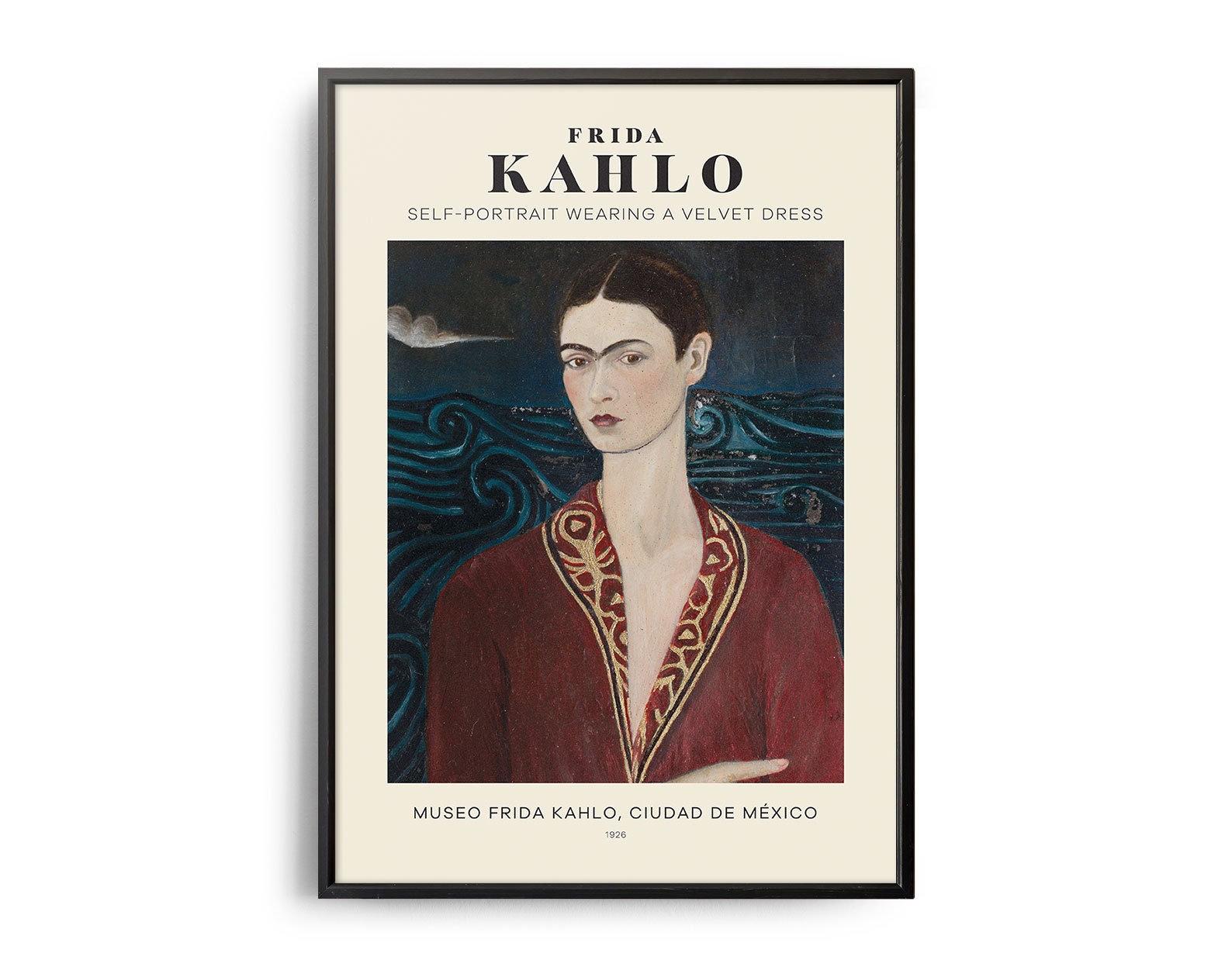
One of the exhibition's standout pieces is Kahlo's Self-Portrait in a Velvet Dress from 1926, a work that marks her early foray into self-portraiture—a genre that would define her career. Painted at the age of 19, shortly after her bus accident, this oil on canvas depicts Kahlo with an elongated neck and piercing gaze, reminiscent of Renaissance portraits yet infused with a modern introspection. The velvet dress, a symbol of elegance and restraint, contrasts with the turbulent emotions underlying her expression, hinting at the pain and identity struggles that would permeate her later works.
This painting, held in a private collection, exemplifies Kahlo's blend of European influences—drawn from her studies of Old Masters—with her emerging personal style. It was created during her recovery period, when she began painting as a form of therapy. In the context of the exhibition, it serves as a foundation for understanding how Kahlo's self-representation laid the groundwork for her iconic status. Art historians often link this work to her relationship with Alejandro Gómez Arias, her then-boyfriend, to whom she gifted the painting.
(Image source: Etsy - Frida Kahlo Self-Portrait)
The Turbulent Bond: Diego and I (1949)
No discussion of Kahlo's life and art is complete without addressing her complex relationship with Diego Rivera. The 1949 painting Diego and I captures this dynamic poignantly. In this self-portrait, Kahlo depicts herself with tears streaming down her face, while a small portrait of Rivera appears on her forehead, symbolizing how he dominated her thoughts. The work, which fetched a record $35 million at a Sotheby's auction in 2021, reflects the emotional turmoil of their marriage, marked by infidelity, separations, and reconciliations.
Part of the Eduardo F. Costantini collection, this piece highlights Kahlo's use of symbolism to convey inner conflict. The third eye-like placement of Rivera's image draws from Mexican folk art and surrealist traditions, underscoring themes of love, betrayal, and obsession. In the exhibition, it underscores how Kahlo's personal narrative fueled her rise to fame, with her story resonating with feminist movements in the late 20th century.

(Image source: Poster Lounge - Diego and I)
Critique of American Capitalism: My Dress Hangs There (1933)
Kahlo's time in the United States, particularly New York, inspired My Dress Hangs There (1933), a collage-like painting that critiques American society. Created during her stay with Rivera while he worked on murals, the work features a Tehuana dress—a traditional Mexican garment—hanging amid skyscrapers, toilets, and capitalist symbols like the Statue of Liberty and Wall Street. This piece, part of the Colección FEMSA, was recently highlighted by ARTnews as one of the 100 best artworks about New York City.
The painting juxtaposes Mexican cultural elements with American industrialism, reflecting Kahlo's disdain for what she saw as superficiality and materialism. It incorporates newspaper clippings and photographs, blending media in a way that prefigures pop art. In "Frida: The Making of an Icon," this work illustrates how Kahlo's political views and cultural pride contributed to her enduring appeal, especially among Latin American artists.

(Image source: Best of Bharat - My Dress Hangs There)
Photographic Insights: Frida with Her Pet Eagle by Nickolas Muray (1939)
Photography plays a crucial role in Kahlo's iconography, and Nickolas Muray's 1939 portrait Frida with Her Pet Eagle, Coyoacán captures her enigmatic persona. Taken in her hometown, the image shows Kahlo holding an eagle, a symbol of strength and freedom in Mexican culture, against a backdrop of lush foliage. Muray, a Hungarian-American photographer and Kahlo's lover, produced a series of color portraits that helped popularize her image.
This photograph, courtesy of the MFA Houston and the Nickolas Muray Photo Archives, is emblematic of how media representations amplified Kahlo's fame. The exhibition includes it alongside merchandise inspired by similar images, showing the commercialization of her likeness.
(Image source: AAA - Frida Exhibition) // Note: This is the exhibition poster, as a close proxy for the specific photo.
Inspirations Across Generations: Rupert García's Frida Kahlo (September) (1975)
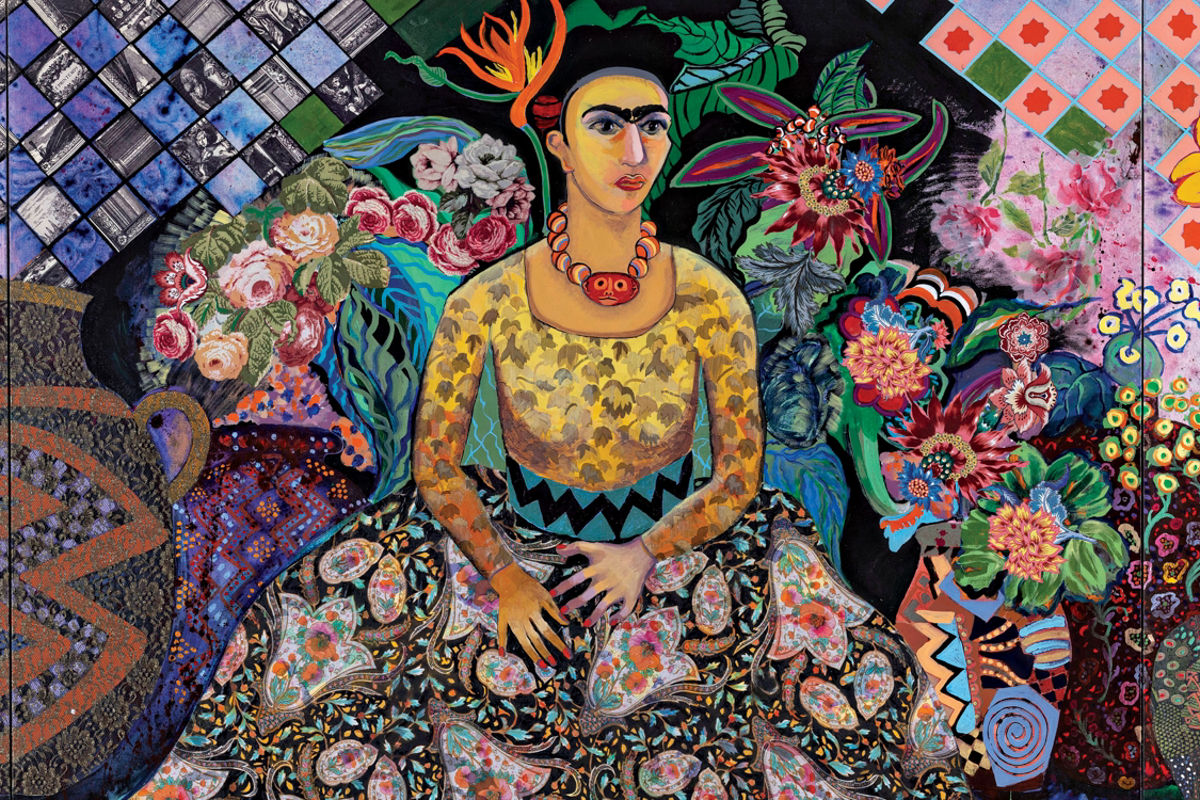
The exhibition extends beyond Kahlo's own works to showcase her influence. Rupert García's Frida Kahlo (September) from the Galería de la Raza 1975 Calendario reimagines her as a Chicana icon. This silkscreen print, part of a calendar series, portrays Kahlo in bold colors, emphasizing her role in Chicano art movements. García, a key figure in the San Francisco Bay Area's activist art scene, uses Kahlo's image to address themes of identity and resistance.
Held by the Fine Arts Museums of San Francisco, this piece demonstrates how Kahlo's legacy empowered marginalized artists, particularly women of color.
(Image source: Smithsonian American Art Museum)
Global Dialogues: Yasumasa Morimura's An Inner Dialogue with Frida Kahlo (Hand-Shaped Earring)
Japanese artist Yasumasa Morimura's An Inner Dialogue with Frida Kahlo (Hand-Shaped Earring) offers a postmodern take, with Morimura impersonating Kahlo in a photographic self-portrait. Part of his series appropriating famous artworks, this piece explores gender, identity, and cultural hybridity. Courtesy of the Minneapolis Institute of Art, it highlights Kahlo's universal appeal, transcending borders and inspiring appropriation art.
In the exhibition, such works illustrate the ongoing evolution of Kahlo's icon status, from feminist symbol to a canvas for global artistic discourse.
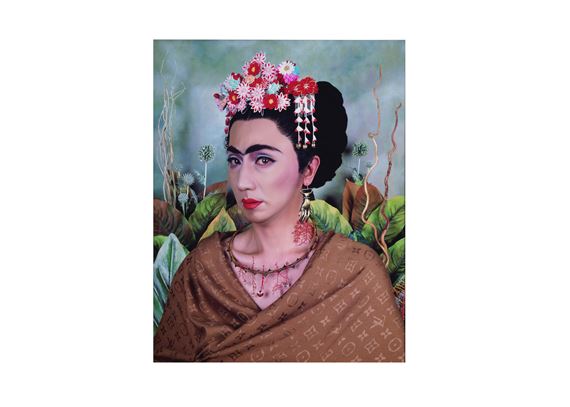
(Image source: MutualArt - Yasumasa Morimura)
The Broader Impact and Archival Treasures
Beyond these highlights, the exhibition incorporates archival materials from the Museo Frida Kahlo, including clothing like her signature Tehuana dresses and jewelry that reflected her indigenous roots. These items provide tangible links to her life, showing how her personal style—braids, flowers, and bold accessories—became integral to her iconic image. Artists like Judy Chicago, Catherine Opie, and Carrie Mae Weems respond to these elements, creating works that interrogate themes of femininity, disability, and ethnicity.
The show also addresses the commercialization of Kahlo's image, with displays of merchandise inspired by her portraits, prompting visitors to reflect on the line between admiration and exploitation. As a whole, "Frida: The Making of an Icon" not only celebrates Kahlo's artistry but also critiques the mechanisms that turned her into a brand, encouraging a deeper appreciation of her contributions to modern art.
FAQ
Q: When and where is the "Frida: The Making of an Icon" exhibition taking place? A: The exhibition opens at the Museum of Fine Arts, Houston, on January 19, 2026, and runs until May 17, 2026. It will then travel to the Tate Modern in London during the summer of 2026.
Q: What is the main focus of the exhibition? A: The exhibition explores the transformation of Frida Kahlo from an artist primarily known as Diego Rivera's wife to a global icon, separating her artistic achievements from her cultural phenomenon status. It features her works alongside those of artists inspired by her.
Q: Are there any key artworks by Frida Kahlo featured? A: Yes, highlights include Self-Portrait in a Velvet Dress (1926), Diego and I (1949), My Dress Hangs There (1933), and others like Moses (1945) and The Heart (1937).
Q: How does the exhibition show Kahlo's influence on other artists? A: It includes pieces by nearly 80 artists, such as Rupert García, Yasumasa Morimura, Judy Chicago, and Martine Gutierrez, who reinterpret Kahlo's themes of identity, feminism, and culture.
Q: Is photography part of the exhibition? A: Absolutely. Photographs by Nickolas Muray, including Frida with Her Pet Eagle (1939), are featured, along with archival photos and modern responses, highlighting how imagery contributed to her iconic status.
Q: Can I purchase tickets or learn more about Frida Kahlo? A: Tickets are available through the MFAH website. For more on Kahlo, visit the Museo Frida Kahlo site or explore resources from Artists Rights Society.