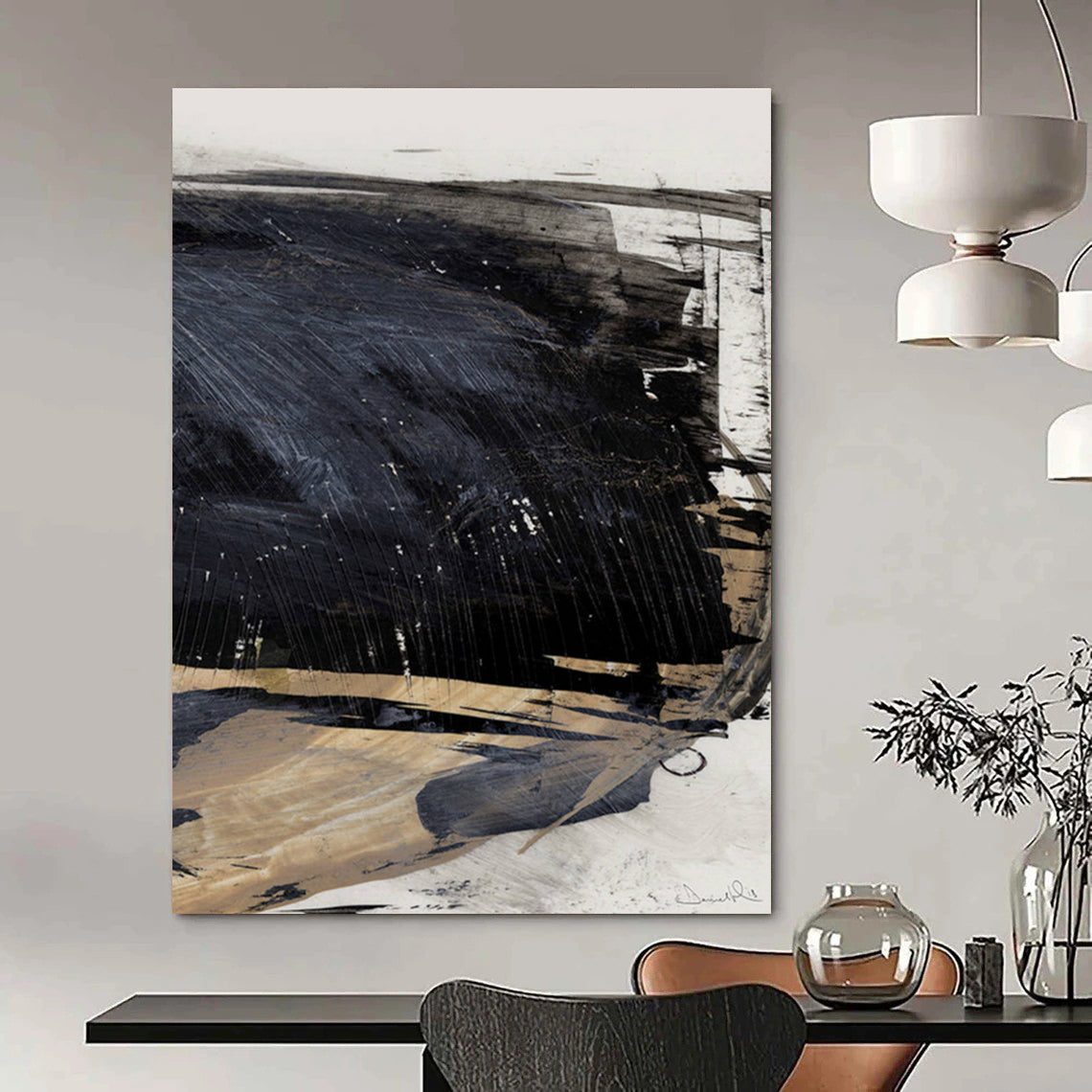

In the realm of contemporary abstract art, few pieces capture the essence of tranquility and introspection as effectively as the Gentle Soft-Toned Abstract Landscape for Restful Spaces HENG226. This canvas print, part of the broader Beige Abstract Art collection, invites viewers into a world of subtle hues and fluid forms, evoking a sense of calm that is ideal for modern living spaces. At first glance, the artwork presents a minimalist landscape, dominated by a vast expanse of creamy beige that fades seamlessly into a hazy horizon. The central element is a soft, undulating band of color—blending muted greens, earthy browns, and hints of turquoise—that suggests the gentle ripple of water or the distant outline of rolling hills. There are no sharp edges or defined figures; instead, the composition relies on blurred transitions and layered textures to create depth and movement. This deliberate ambiguity allows the piece to transcend literal representation, aligning it with the principles of abstract art, where shapes and colors evoke emotions rather than depict reality.

The content of this abstract painting can be dissected through its visual elements. The dominant beige backdrop serves as a neutral canvas, symbolizing openness and peace, much like a blank sky at dawn. This choice of palette is not accidental; beige tones are often associated with warmth and subtlety, providing a restful foundation that soothes the eye. Intersecting this expanse is the horizontal streak, which appears almost ethereal, as if painted with a soft brush or even scraped with a palette knife to achieve a textured, watery effect. The greens and blues within this band hint at natural elements—perhaps a serene lake or a misty meadow—yet they remain abstracted, encouraging personal interpretation. One might see it as a metaphor for the boundary between earth and sky, or the ebb and flow of time. The overall vertical orientation of the canvas, resembling a tall panel, enhances its meditative quality, drawing the viewer's gaze upward in a contemplative manner. In terms of technique, the blending suggests influences from Abstract Expressionism, where artists like Mark Rothko used color fields to convey profound emotional states, though here the scale is more intimate and subdued.
Delving deeper into the artist's background, HENG—whose full name is Heng Li, a pseudonymous contemporary artist based in Shanghai—has carved a niche in creating works that bridge Eastern philosophies of harmony with Western abstract traditions. Born in 1985, Heng's journey into art began in his early twenties after studying traditional Chinese ink painting at the China Academy of Art. Initially focused on representational landscapes inspired by the misty mountains of classical Chinese scrolls, Heng experienced a pivotal shift during a residency in New York in 2012. Exposed to the raw energy of Abstract Expressionism, he began experimenting with non-objective forms, stripping away literal details to capture the essence of serenity. "I wanted to distill the feeling of peace from nature, without the distraction of specifics," Heng has shared in interviews. His creation process for pieces like HENG226 involves layering acrylics on canvas, often using unconventional tools like sponges and cloths to achieve diffusion. This method reflects his ideology of "soft abstraction," where art serves as a sanctuary from the chaos of modern life. Influenced by Zen Buddhism, Heng's works aim to promote mindfulness, encouraging viewers to pause and reflect. Over the years, his portfolio has evolved from vibrant experiments to the muted palettes seen in his Restful Spaces series, launched in 2020 amid global uncertainties, as a response to the need for calming home environments.

Heng's creative ideology centers on the concept of "wu wei," or effortless action, drawn from Taoism. He believes that true beauty emerges not from forceful depiction but from allowing colors to flow organically, mirroring the natural world's impermanence. For HENG226, the inspiration stemmed from a trip to the Gobi Desert, where the vast, sandy horizons blended with faint oases. Rather than photographing or sketching, Heng internalized the scene, later translating it into abstract layers in his studio. This process underscores his journey from rigid academic training to intuitive creation. Early in his career, Heng faced criticism for abandoning traditional forms, but exhibitions at galleries like the Shanghai Museum of Contemporary Art in 2015 validated his approach. By incorporating elements of abstract art history, such as Kandinsky's emphasis on spiritual resonance through color, Heng has positioned himself as a bridge between cultures. His works, including this piece, are designed for restful spaces—bedrooms, meditation rooms, or offices—where they act as visual anchors for relaxation. The soft-toned landscape isn't just decor; it's an invitation to emotional respite.
Analyzing the painting's impact on viewers reveals its therapeutic potential. In a fast-paced world, artworks like this offer a counterbalance, promoting mental well-being through visual harmony. The blurred horizon line creates an illusion of infinity, fostering a sense of expansiveness that can alleviate stress. Color psychology plays a key role here: beige evokes stability and neutrality, while the subtle greens suggest growth and renewal without overwhelming the senses. This aligns with broader trends in interior design, where minimalist abstracts are favored for their versatility. For instance, in therapeutic settings, such pieces are used to encourage introspection, much like how Rothko's color fields were intended to envelop the viewer in emotion. Heng's technique of subtle gradation ensures the piece evolves with lighting—appearing warmer in daylight and more mysterious at dusk—adding a dynamic layer to its static form.
Customer feedback further illuminates the piece's appeal. Sarah Thompson, a yoga instructor from California, shared, "I hung the Gentle Soft-Toned Abstract Landscape for Restful Spaces HENG226 in my studio, and it instantly transformed the space. The soft colors help my clients relax during sessions—it's like a visual breath of fresh air." Similarly, Michael Grant, an architect in New York, noted, "As someone who appreciates Beige Abstract Art, this canvas fits perfectly in my minimalist home office. The abstract quality sparks creativity without distraction." Another buyer, Elena Vasquez from London, added, "I was drawn to its calming vibe after a stressful year. It's more than art; it's therapy on the wall." These testimonials highlight how the painting resonates on a personal level, reinforcing Heng's intent to create accessible, emotionally supportive works.

Expanding on the historical context, this piece draws from the evolution of abstract art in the 20th century. Pioneers like Wassily Kandinsky, as discussed in resources from Khan Academy, sought to express inner realities through non-representational means, a philosophy echoed in Heng's soft-toned approach. Unlike the bold gestures of Pollock, Heng opts for restraint, aligning more with Color Field painters who prioritized atmospheric immersion. This restraint is evident in the painting's composition, where negative space dominates, allowing the subtle band to breathe. In terms of materiality, the canvas print format enhances accessibility, making high-concept art available for everyday spaces without compromising quality.
Heng's artistic journey also reflects broader shifts in global art markets. Starting with local exhibitions in China, he gained international recognition through online platforms and collaborations with design firms. By 2018, his works were featured in Milan Design Week, where the Restful Spaces series debuted to acclaim. Critics have praised his fusion of Eastern minimalism with Western abstraction, noting how pieces like HENG226 embody a "global serenity." His process involves meditative preparation—often beginning with tea ceremonies—to ensure authenticity in each stroke. This dedication has led to a prolific output, with over 200 pieces in the series, each uniquely coded like HENG226 to denote variations in tone and texture.
The painting's thematic depth extends to environmental commentary. The abstract landscape subtly nods to climate change, with its hazy forms suggesting dissolving boundaries in nature. Heng has spoken about this in lectures, emphasizing art's role in fostering awareness without overt messaging. This layered meaning adds intellectual weight, making it suitable for discerning collectors.

In conclusion, the Gentle Soft-Toned Abstract Landscape for Restful Spaces HENG226 exemplifies Heng's mastery in crafting serene abstractions. Through its soft palette and fluid forms, it offers a haven for the mind, rooted in a rich artistic lineage. As part of the Beige Abstract Art genre, it stands as a testament to the enduring power of abstraction to heal and inspire.
FAQ
What materials are used in the Gentle Soft-Toned Abstract Landscape for Restful Spaces HENG226?
The artwork is printed on high-quality canvas using archival inks, ensuring fade-resistant vibrancy for years.
How can I incorporate this piece into my home decor?
It's versatile for restful spaces like bedrooms or living rooms. Pair it with neutral furniture to enhance its calming effect.
Is the artist Heng Li's work available in other sizes?
Yes, custom sizes are offered on the product page. Check the link for options.
What inspired the Restful Spaces series?
Heng drew from natural landscapes and Zen principles to create pieces that promote relaxation in modern environments.
Are there similar pieces in the Beige Abstract Art collection?
Absolutely—explore the collection for more soft-toned abstracts.
(Word count: approximately 1520)